
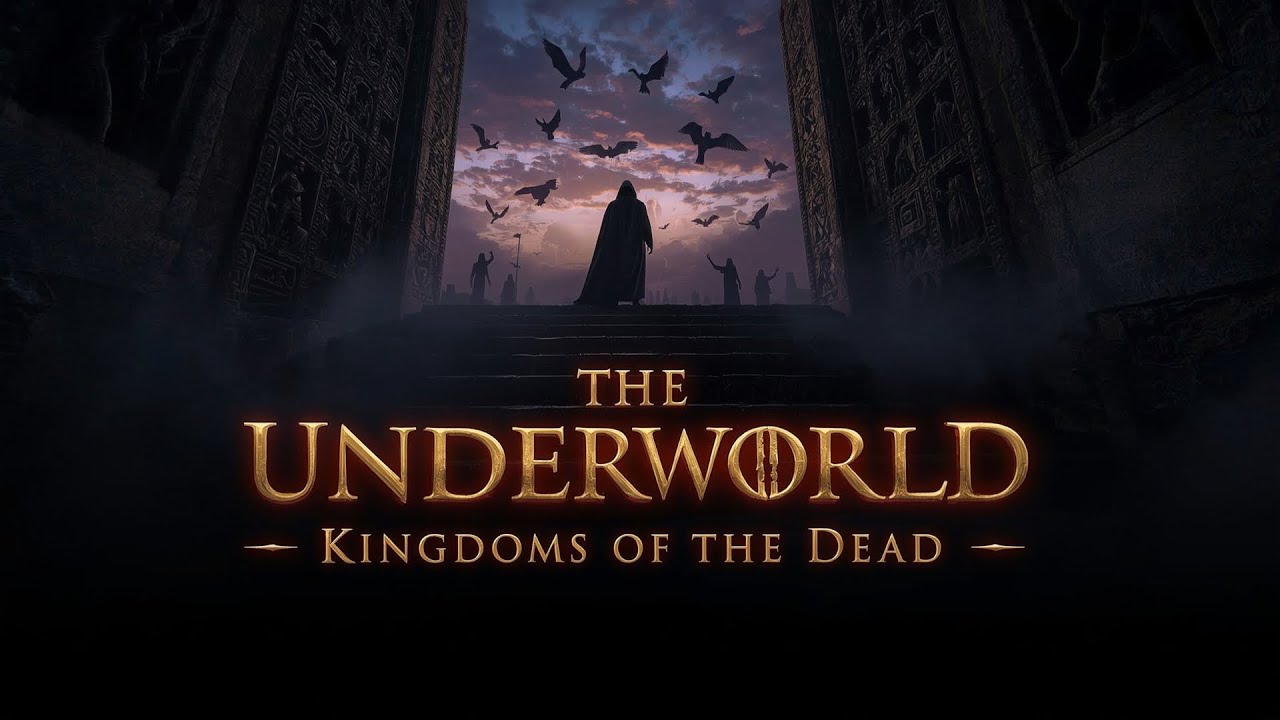
The Underworld – Kingdoms of the Dead | Relaxing History for Sleep
The call from the Other Side. The tale of a pilgrim who has walked through the realms of death, not to die, but to look back at life. I no longer remember how the wind blew that afternoon. I only remember standing silently by a riverbank, nameless, without a dock, without a boatman. The water was so still, it felt as though it didn’t exist. Yet something on the other side was calling to me. Not with words, but with silence. A silence thick as ancient night, not dark, not cold, just deep. Deep as the memory of a soul freshly severed from its body, searching for a path through fields that have never appeared on any map. I’ve lived my whole life with questions about death. Not as someone who fears it, but as someone drawn to it. I’ve read the Egyptian papyrus scrolls with drawings of Duat, the afterlife where raw battles each night to bring back the dawn. I’ve studied Greek stone carvings that speak of Hades, the realm of those whose names are forgotten. I once trembled when I first understood Nephilim, the land where cold souls are forever denied the title of hero. And then I realized every civilization has a door. A door not opened by hands, but by memory, faith, and the acceptance that there are things we can never carry with us when we cross. The living build cities, raise statues, write epics. The dead build worlds from shadows, dreams, and things no one speaks of anymore. And between those two shores, there is a place called the border. I stood there not to die but to listen. To listen to the nameless call from kingdoms without maps. Where roads are paved with fire, with rivers of blood. With things only souls understand, where there is no light but not total darkness either. Someone once asked me, “Why seek the realm of the dead while you’re still alive?” I only smiled. Because sometimes it is death that holds the most sacred truths of life. And that was when my journey began with a single step, a notebook, and a breeze no one could see. Duat, the path of Egyptian souls. One does not enter duat with feet, but with the memories of those who walked before. I arrived in Egypt during a windless winter. The sky was gray and dim, as if the gods themselves were silent in mourning for something. Not the death of a person, but death, as a concept once understood more profoundly than anywhere else on this earth. In ancient Egypt, people did not believe that death was an end. They believed it was a journey. And that journey had a name, duat. Dat was not heaven, nor was it hell. It was the afterlife. A realm every soul must pass through. A long, dark path filled with trials, monsters, and gods. Each guarding a piece of the truth, and each piece capable of either saving or destroying the soul. I once stood inside an ancient tomb, deep beneath the limestone of the Valley of the Kings. The walls were painted from ceiling to floor depicting the nightly voyage of the god Rah through dat. Yes, Rah, the Egyptian sun god, had to die at the end of each day. And when the sun set, he did not disappear. He descended into duat, carrying light, carrying hope, and fought through the night in order to rise again the next morning. During the night, Rah had to face Apep, a giant serpent of chaos born of primordial darkness. Apep does not die. He is slain each night but returns to life when the darkness comes again. Someone once asked, “If Apep rises every night, what is the point of Ra fighting endlessly?” I think that question itself holds the answer because light is not a given. It is the result of an eternal battle. Just like life, just like waking up each morning. Duat is not just the story of the gods. Every Egyptian who dies, whether pharaoh or farmer, must pass through duat. Their heart will be placed on a scale. On the other side lies the feather of Mahat, goddess of justice, truth, and cosmic order. If the heart is too heavy with sin, deceit, or unfulfilled ambition, then Amit, the soul devouring beast, will tear it to pieces. And that soul will not be reborn, not enter heaven, not be condemned to hell, just vanish. No name, no memory, nothing at all. Total disappearance. That was what Egyptians feared the most. I remember the first time I read the book of the dead. It was not a book about death, but a guide for passing through death. In it, the soul must travel through 12 regions of Dwat. Must learn the secret names of the gates. must answer questions posed by gods with falcon heads, jackal heads, crocodile heads. Must know its own name, the name of its guardian spirit, and the names of the stars that guide it. Not to show off knowledge, but to prove one is worthy of being remembered. Duat, in the Egyptian view, was not a place for judging sins, but a place to restore order to the universe. The living had to prepare their entire lives for that journey. They embalmed the body to preserve its form. They carved their names in stone to avoid being forgotten. They painted images of protective gods on the tomb walls. They placed amulets on the chest so the heart would not betray them on the scale because without preparation, Dwat would swallow the soul like a bottomless river. I once sat for hours before an ancient painting in the tomb of Si. The god Anubis, jackal-headed, was leading a soul through a stone gate. Behind was the soul, holding a scroll with its name. Ahead was a dim golden light like the first dawn. I wondered, are we all preparing for such a journey? Each action we take, each word we speak, are they carving a map for duat onto our very soul? The Egyptians did not build pyramids to live. They built them to die with dignity. For in death they saw a trial. And in that trial, the chance to be born again, better, more complete. I left Egypt with a strange feeling, not fear, not sorrow, just an understanding that death is not an abyss. It is a door. And one who has a name, a memory, and a heart that knows balance will find the way. Hades, where the nameless dead wait. Not all who die are remembered, but all must pass through this place. I arrived in Greece on an October afternoon when the golden sunlight had turned the color of wine and the wind carried the scent of rotting leaves beneath the hills. Beneath the shade of an ancient olive tree older than any temple nearby, I sat down, opened my notebook, and wrote the first line. If the soul still has a road to travel, then Hades is the final point where even memory cannot follow. In Greek mythology, Hades is not the name of an evil god. It is the name of the realm of the dead and also the name of the god who guards that place. There are no roaring fires, no eternal torments for sinners like in the Christian hell. Only an eternal darkness, a thick silence where all souls become the same. faint, formless, voiceless, with no one remembering who they once were. The ancient Greeks believed that when a person dies, their soul is led by Hermes, the guide of souls, to the banks of the river sticks. There, a fairy man waits. Kon, who never lifts his head, never asks a name, only holds out his hand for the coin placed beneath the tongue of the dead. What if there is no coin? That soul will wander the banks of the sticks forever, never crossing, never forgetting, never reborn. Just a sense of being lost, stretched into infinity. There are five rivers flowing through Hades. Each river is not just water, but an emotion crystallized into the current of the underworld. Sticks, the river of sacred oaths and forgetting. Lethy, the river of oblivion, where souls drink to forget their names, their lives, and the fact that they once lived. Flegthon, the river of fire, of punishment and burning. Aaron, the river of sorrow, whose waters are saltier than blood. And Cocatus, the river of wailing, where sobss never cease. The Greeks did not build an image of the underworld to threaten. They created Hades as a mirror of the human world where even souls must search for themselves in the dark. After crossing the river, the soul reaches the gate of Hades, guarded by Cberus, the giant three-headed dog who does not sleep, does not stray, and never lets a soul return. I once saw a carving of Cberus on a black vase. It did not roar, did not attack, only watched. And I suddenly understood. In the Greek world, death was not an enemy. It was an irreversible event. And Cberus was the symbol of that. In the kingdom of Hades, the soul is judged by three kings. Minos the just, Ratamanthus, the stern, Akis, the keeper of the key to Destiny’s gate. If a soul lived a noble life, they were sent to Allesium, a place of gentle light, endless fields, music that never fades, and memories that never leave. If they lived in sin, they were sent to Tardus, deeper than Hades, where only the most dangerous souls are imprisoned. Most souls, however, enter Asphodel, the misty field where spirits wander unpunished, unrewarded, simply existing in forgetfulness. I once asked an old Greek scholar why the Greeks feared being forgotten more than being punished. He answered, “To us, to exist is to be remembered. A god exists because someone prays. A hero lives on because someone tells their story. But if no one calls your name, you are no more. [Music] Hades is not hell. It is a repository of human memory where everything that cannot be held onto is stored forever. Not for punishment, but to wait for someone to remember. I once lay beneath that olive tree, close my eyes, and imagine myself a soul crossing the river leafy. If I drank its waters, I would forget my name. I would forget all that I loved. Those who once called me, wept for me, held me in memory, and perhaps I would feel relief. But perhaps it is pain that makes us human. The Greeks believed that the soul would eventually be reborn. After enough time, after forgetting everything, the soul would return to the world, carrying something faint, like a familiar feeling, a reoccurring dream, or a nameless longing. Perhaps you carry within you a fragment of someone else’s memory. And if so, then Hades was never the end. Only a pause for the old self to fade and the new one to be born. Naraka, the journey of karma. When death is not the end, but a transit station for cycles of rebirth yet to be complete. I arrived in India during the monsoon season. The sky remained silvery gray for days and the red dirt roads turned slick. as if even time itself hesitated before something sacred. One morning, I sat in the courtyard of an ancient temple. Rain still fell softly. In front of me was a stone relief carved with an image of a river of fire and souls trapped within the waves of their own karma. No one screamed. No one struggled. Only acceptance and eyes as if they knew that everything happening was the result of their own doing. I asked a monk, “Is this hell?” He smiled, shook his head and softly replied, “No, this is Naraka and Naraka is a mirror of the mind.” In both Buddhist and Hindu teachings, Naraka is not a place of eternal punishment. It is not ruled by an evil god. There are no fires burning forever, nor gatekeepers delighting in the suffering of others. Nuraka is an intermediate realm. A place where the soul after death pauses to repay karma before being reborn. And that karma does not come from judgment nor sentencing. It is simply the natural result of every action, word, and thought one has swn in past lives. There are many levels of nuraka. In Buddhism, it may be eight great hells and countless lesser ones. In Hinduism, sometimes 21 levels. Each corresponds to a different kind of karma. Killing, desire, deceit, arrogance. Not to punish, but to see. To clearly see the consequences of what once seemed trivial. to truly see the pain once inflicted now returned not as vengeance but for balance. The living often think I haven’t done great evil so what is there to fear but Naka does not measure by scale it measures by intent. A harsh word may seem light as air. But if it causes a lifetime of hurt, then the waves of karma have already begun. And Naraka keeps no records. The universe remembers all. I once read in a sutra, “A person falling into Naraka may be burned, frozen, cut, chained, but all are symbols of the dissolution of the ego.” At the deepest level, there is no fire, no weapons, only absolute solitude. A soul wandering in endless void, unnamed, unremembered, with nothing to hold on to. It is not abandoned by others. It abandons itself. I asked the monk, “Is there a way out of Naraka?” He answered, “Of course, because Naraka is not eternal like the monsoon. It comes and goes. Once karma is repaid, the soul will be reborn, whether as a human, an animal, or even a star. I fell silent. In many religions, the realm of the dead is the end. But here it is purification, like water passing through sand before returning to the spring. A story I will never forget. There was a murderer. After death, he fell into Naraka, suffering endless blows and cuts. But in each strike, he saw the eyes of those he had killed. Not eyes of hatred, but eyes asking why. And each time he took a step back from the darkness until one day he wept not from pain but from understanding. At that moment the gates of Naraka opened. I once dreamed of a redstone path on either side rivers of blood and mountains of ash. I walked through unimpeded, unguided, only a voice echoing in my mind. You are witnessing what you once sowed. I was not afraid, only calm, like someone who had finally looked into the darkness within their own heart. Perhaps that is why Indians do not perform rituals begging forgiveness for the dead. They only pray that they are cleareyed enough to see and to pass through. Naraka does not teach fear. It teaches responsibility not to burden but to liberate oneself from what one has never dared to face. And as the monk said before I left, we are all walking through Naraka every day with every action. Only by living with quiet kindness will we never need to fear any level of hell. Helheim, the land without heroes. When death does not come from battle, it becomes quieter and far colder. I arrived in Norway at the end of winter when the sun rose only for a few hours each day and the sky bore the gray hue of cold steel. The wind here did not blow in gusts. It shrieked through wood, through flesh, and at times through sleep. I remember sitting by the fireplace in a small wooden cabin deep in the forest. An old Sami man sat across from me. I asked, “What did the ancients believe happens after death?” He didn’t answer right away. He simply tossed another log into the fire. The flickering flames cast shadows across a face deeply folded by time. And then he said, “If you die on the battlefield, Valhalla will open its doors. But if not, you will go to Helheim. Helheim, not hell, not heaven, but a land of silence.” In Norse mythology, Helheim is the place for those who die an ordinary death. By illness, by old age, by accident, any death not deemed glorious. No warriors, no war cries, no feasting halls with Odin. Only darkness, white snow, and a goddess who rules it. Hell, daughter of Loki. Half her face that of the living, the other half of a corpse. The Norse did not carve statues of hell and gold. They etched her name into bone. They called to her during snowstorms, not to beg, but to remind one another that there is another kind of death, not glorious, but not to be forgotten. Helheim lies at the far end of Idrasil, the world tree, where its roots touch shadow. The road there holds no fire, only ice. Ice as thick as forgotten memories. Ice as cold as unsaid farewells. And upon that ice, souls walk slowly with no one calling their name, no one welcoming them. No punishment, but no forgiveness. Only existence, stretched out, colorless, tasteless, endless. I once read a line in the prosetta. Those souls who are not sung of will fade into Helheim like breath into snow. What the Norse feared was not pain. It was silence. A death never spoken of. A life never remembered. Hell, the goddess of this place neither smiles nor rages. She simply watches. One half of her face vibrant with life. The other white bone and hollow eye. Not to threaten, but to remind us that within every human, life and death always walk together. I once dreamed of a white featureless land. No sky, no earth, only a space of blinding snow. In that dream, I walked past thousands of silhouettes. They felt no pain, spoke no words. They only stared, not at me, but through me. When I awoke, I wrote in my notebook, “Perhaps death is not absence, but merely the gaze no longer returned.” People often speak of Valhalla, where warriors gather after death, raise their cups, and await Ragnarok. But Helheim holds souls, too. Mothers who died in childbirth. Old men who died in the cold. Children who passed before ever seeing sunlight. They are not sung of, but they are still there. When Ragnarok comes, the end of days in Norse myth. It is not only Valhalla that opens. Helheim too will rise. And Neath Hugger, the giant black dragon, will carry those forgotten souls, rising from snow, piercing smoke, charging into the final battle. Not to win, not to conquer, but to be seen. Helheim, a land not for heroes, but also not for the cowardly. It is the place of ordinary souls. Those who lived without renown died without song. And for that very reason, it deserves to be remembered. I left the village that day as snow began to fall more heavily. The old Sami man looked at me and said one last thing. You don’t need to die in battle to be remembered. Just live in such a way that when your night comes, someone lights a fire and speaks your name beside it.” I nodded and I knew from that day on, every time the snow fell, I would not think only of winter, but also of Helellheim, Mklan, the Aztec world of darkness. Not all deaths lead to light. Some souls must pass through nine layers of darkness before becoming part of the cosmos. I arrived in Mexico in the middle of the dry season. The sky was so blue it felt like stepping into a painting made of blood and sunlight. The air carried the scent of ash and pine resin, the familiar aroma of ancient sacrificial rituals. My guide led me to the base of the pyramid at Chichinita and said, “Here, the gods do not grant blessings. They wait to be remembered.” I looked down at the worn stone steps beneath my feet. Thousands had climbed them, not to descend again, but to meet death as a sacred right. In Aztec civilization, death was not an ending. It was a journey, harsh, mystical, and necessary. The Aztecs believed that after death, the soul did not rise to heaven. It descended down into a world called Miklan, the realm of the deepest shadows. Ruled by Miklan Tuti, the white-boned god whose smile never fades. Miklan was not a place for the wicked. It was meant for most people, those who died of old age, illness, or without the sacred blood of sacrifice. There the soul must pass through nine levels of the underworld. Each a trial not for punishment but to cleanse the traces of the earthly world. The first level is upon aa a wide and raging river. The soul must cross it with the help of a dog. The sholoets. Only those who were kind to dogs in life would be guided. I lingered here for a long time just to write one line in my notebook. The afterlife remembers how we treated those weaker than ourselves. The second level to pedal Mona Miklan is two massive mountains that crash into each other. The soul must quietly wait for the moment they part to slip through. If too slow, it is crushed. If too hasty, it loses its way. The third level, itsayen, is where icy winds slash at the soul like blades. There is no shelter, only endurance and silence. The fourth level, Punquetla Caloan, is where sharp blades hang in the air, tearing at the spirit. The fifth timoan where endless arrows pierce the soul wounding memory. The sixth touquan where the heart is devoured yet the soul remains alive to witness it. The seventh italapan a road paved with obsidian blades slippery and reflecting the soul’s own face. I wrote here we do not walk to reach a place. We walk to look back at ourselves. The eighth level, Tisokan, is a realm of total darkness. No shape, no sound, no color. Only pure and solitary awareness remains. And the ninth level, Chikuna Miklan, is the final stop. The soul pauses. No one greets it. No one questions it. only Miklantuti standing among thrones of human bones silently watching each soul arrive and then letting them dissolve into the earth to become part of the universe. I asked the guide there’s no heaven. He replied, “There is, but not for everyone. Those struck by lightning ascend to the skies. Those who die in war or sacrifice enter the sun. Women who die in childbirth become moon goddesses. The rest go to Miklan. But he added something I could never forget. No one returns from Miklan. But if remembered, the soul never fully disappears. I understood why modern Mexicans still celebrate Dia de los Muertos, the day of the dead. Not to mourn, but to let souls continue through memory, through sweet bread, through maragolds, and through stories told at night. I once sat alone in a cemetery in Waka as locals placed candles in long rows like rivers of light. Children played among the graves. Elders strummed guitars. And I wondered, perhaps Miklan isn’t frightening. Perhaps we only fear it because we forget that death too needs to be lit. Miklan is not meant to frighten. It is a map to return to the earth to become wind, flame, the sound of ancient drums echoing through the jungle. There the soul is not judged. It only needs to walk far enough to shed its old self. Kare the leap into the sea of souls. I once stood in Kad Kad on a misty afternoon where gray waves crashed endlessly against the black sand as if calling someone from the other side of the world. There were no temples, no giant stone statues, no ancient scriptures. Yet every gust of wind brushing against my skin felt like a distant legend of death and the sea crossing. every Mai soul must undertake. At the edge of this world, where jungle meets cliff and the ocean touches the sky, the Mai believed the soul of the departed must journey to an ancient headland called Caprainga, where an old pohutukawa tree grows out of the rock, its roots reaching down to the sea like a faded staircase into the afterlife. From there, the soul will step into the ocean. There is no golden gate, no beast headed guardians, no gods holding scales, only a leap into cold, murky, wordless water. The Maui call it Wua, the leaping place of souls. Death is not a door that slams shut, but a gentle wind that pushes the soul away from the body, like a small wooden canoe drifting out to sea, unmanned. And if that soul had done wrong, no one punishes. No burning hellfire, no monsters, only cold seas, rip currents, mist, and loneliness. They say lost souls will forever drift across the ocean, unable to find Hayiki, the island where the ancestors wait. They will hear the songs of ancient spirits, but never understand the words. I once asked a Mai elder, if the sea is the road of death, then where do we come from? He did not answer immediately. He simply pointed out beyond the horizon where the dusk blurred into the ocean. We came from Hawaii, the first island of souls. From there, our ancestors sailed to this land. And in death, the soul returns. Death is just the journey home, but in reverse. I asked again, “Has anyone ever returned from the sea?” He smiled. “Yes, in dreams. When we are truly silent, when we listen to our hearts the way we listen to the waves. In Maui belief, there is no absolute divide between the living and the dead. The souls of the departed still exist in the wind, in the water, in the crackling fire, and in the twilight songs. When someone is dying, the whole village sings, not to hold them back, but to send them off because everyone must walk to that shore. Everyone must stand at Kadare, where land ends and the ocean begins. And there the wind from the sea will ask, “Have you lived well?” There’s a tale I once heard from a boatman. When a soul reaches kad, if it still clings to something from the living world, a grudge, an unfinished love, a broken promise, it cannot jump. It lingers at the cliff, becoming a cold wind, a lost bird’s cry, or a fish no one can ever catch. But if the soul is light, if it has let go, it will step into the sea as if coming home. The sea will open and the waves will carry it. I stood there at twilight when the sun dropped into the ocean like the final red drop of the day. I imagined an old man, cloak fluttering in the wind, silver hair flowing, standing at that cliff, silent, unafraid, without regret. Then he lifted his foot and stepped down. There was no sound, only water. And within the water, I saw a fleet of small wooden boats drifting far away toward the setting sun. On the boat there was him, but also me and everyone who had ever loved, ever suffered, ever lived, now returning. Perhaps death is not a loss, but a return. A return to the sea, to the ancestors, to the origin we never truly forgot. And if one day you find yourself at the shores of Kad, when the evening mist begins to roll in, stand still. You just might hear from far across the waves the soft dip of a paddle. A soul returning home. Zubalba, the bloodgate of the Maya. The words of one who once heard the heartbeat of mankind echo in the depths of the earth. I once stood at top a Mayan pyramid on a windless afternoon. Before me lay a dense jungle where time seemed to have died with the gods. But deep below, beneath red earth and limestone, was the place ancient people whispered of, Zebala, the underworld, the realm that every soul must pass through to reach liberation. Not a heaven, not a hell, but a bloodstained gate where the human soul is tested to its very limit. Zebala in the Mayan tongue means place of fear. No one enters it and leaves with light still in their eyes. It is not a simple cave, but a labyrinth of trials ruled by death gods. Each step a riddle. Each chamber a trap for the spirit. The Maya believed that when a person dies, they begin a journey through nine levels of Zebala. each corresponding to a trial of body, mind, soul. Only after conquering all may the soul be reborn or reunited with the universe. In the ancient texts of the Papal Vu, the Mayan sacred book, the twin brothers, Hunapu and Jabalank, once descended into Zebala to avenge their father, who had been defeated by the death gods. They did not fight with swords and spears, but with wit, cunning, and resilience. For Zebala does not kill with brute force. It kills with illusion, with humiliation, with stripping the soul of belief in itself. I recall a carving deep inside Actunachil Muknal, one of the cave entrances believed to lead into Zebala. On the stone ceiling, an ancient Maya inscription. He who does not know who he is shall never escape. The first trial is the house of darkness. No light, no sound. The soul loses all sense of time. Some believe they have only spent a few hours inside. Outside, an entire rainy season has passed. Then comes the house of blades, where knives fly through the air. A single moment of fear and the spirit is slashed. Next is the house of cold, the house of fire, the house of beasts, and finally the house of skulls where the soul must face its own image after death. I once asked a Maya scholar, why did the Maya believe in such a harsh afterlife? He smiled. Because for them, death wasn’t an end. It was the final test to determine whether a person was worthy of returning to the universe as something greater. In Maya culture, blood is the holiest offering. They did not spill it for violence, but because they believed blood nourished the gods. It was the bridge between the world of the living and the dead. On sacred days, they would release blood into the cenote wells, the gateways into Jabalba. Not to appease the death gods, but to speak, to ask permission, to say, “We are ready to enter without fear. I once saw a carving of the god Camzots, the bat god, one of the lords of Zibalba. He did not roar like dragons or breathe fire. He flew silently and took heads in the dark. He was not a demon. He was the keeper of balance. And I wondered, perhaps the afterlife envisioned by the Maya isn’t so different from the inner world of each human being. We too must walk through darkness, through wounds, through fear. We too must shed our old selves, our masks, our illusions before becoming something new, brighter, stiller, and closer to the cosmos. There is a legend that says, “Whoever passes through all of Jabalba with an intact heart will be transformed into a star, forever shining in the night sky, guiding lost souls home. I love that image because it gives me hope that even in the deepest darkness of the afterlife, light can still be born. Jabalaba does not kill the soul. It only takes away what was never real. The gate of Anoyo, Japan. The path between the living and the dead, where memories dissolve into mist. I once set foot in a small village in northern Japan. There were no tourists, no bright electric lights, only snowcovered forests and the wind whispering through bamboo blinds hung at every doorway. The villagers still held an ancient belief that between this world and the next, there is a gate called Anoyo. Not hell, not heaven, but another place. A silent realm where the soul lingers after the body fades, but hasn’t fully left the world behind. I remember that night. An old man led me to the edge of the forest where a wooden bridge spanned a small stream. “Do you see the gate?” he asked. I shook my head. He smiled gently and said, “Anoyo has no shape. But when someone you love passes on, that gate will open in your heart and their soul will pass through it.” In the traditions of Shinto and Japanese Buddhism, death is not an end, but a transformation. The dead step through an invisible gate into a noyo, the other world. But not all can pass. Some linger. Some return in dreams. Some wander endlessly through a fogbound realm known as yomi, a place where light cannot reach. And that is the tragedy. When a soul cannot cross the gate. In Japan, people do not worship ancestors out of fear, but to stay connected, to remind the soul, you are not forgotten. During the festival of Oon, millions of families light lanterns, hang lotus flowers, and float lights down rivers. It is believed that for three brief days, the gate to Anoyo opens. The dead return to visit the living. Not with words, but in the rustling of curtains, the echo of footsteps at night, the faint scent of incense that no one lit. I once sat beside an old monk in Nar. He said, “There are souls who stand before the gate of Anoyo and cannot cross. They carry regrets, resentment, or unfulfilled love. And so they become ureay, wandering spirits. Uure are not terrifying. They are sorrowful because the one thing they long for is not escape but to be heard. At an ancient temple, I saw a painting of Sanzu Nokawa, the river dividing the world of the living from the dead, like the Greek river sticks. To cross it, one must pay a coin. Those without are swept into the muddy current, forever denied the far shore. Perhaps that’s why old Japanese custom places a small coin beneath the pillow of the dead. A final ticket for the final journey. I also once met a young woman in a white mask, standing silently before her family altar. She didn’t cry. She said nothing. But when I asked what she believed about death, she answered, “I believe when we die, we walk through a misty forest. If our heart is heavy, we get lost. But if it’s light as a flower petal, we see the light and the gate opens.” I’ve never forgotten those words. The gate of Anoyo has no guards, no iron doors, no mighty gods. It has only one condition. The soul must let go. Let go of anger. Let go of pain. Let go even of what we once loved most deeply. In a dream, I saw myself walking through a forest, mist cloaking the path. There was a narrow wooden bridge, slick and fragile. On the other side, light. I wanted to cross, but my feet were heavy as stone. And I understood I hadn’t let go of the past. I woke in the night, silent. Perhaps Anoyo is not a place at all. It lives in the heart of every person. And the journey to pass through that gate is the journey of a lifetime. Bardo, the gate between moments. [Music] The account of a Tibetan practitioner who once walked through the dreams of death. I was once asked, “Do you believe in the afterlife?” I didn’t answer immediately. I only looked out at the snowcapped mountains melting quietly into the mist. To the Tibetan, death is not a closing door, but an unfolding journey. No eternal hell, no blinding heaven. Only Bardo, the intermediate state where souls drift in silence. Between the final moment of life and the first moment of rebirth, between the last breath and the first cry born somewhere else. They say there are six types of Bardau, but one name I will never forget. Chikai Bardau, where the soul leaves the body and encounters the primordial light, the pure light of the dharma body. It has no shape, no sound, no color. And for that very reason, most fear it. That light if recognized can liberate the soul from the cycle of rebirth in an instant. But if the mind still clings, still fears, still carries resentment or unrelenting desire, then that light becomes a storm of fire and the soul slips into the next bardo. I once read the Tibetan book of the dead, a scripture placed by the pillow of the dying to be whispered into their ears for 49 days. Not to chant for deliverance, but to guide, to remind the soul wandering through realms. Do not fear the visions. They are illusions of your own mind. Do not flee. Look at them directly. For if you know they are illusions, they will vanish like smoke. Bardo is not a place. Bardo is a state, a moment between two things, between one breath and a thought. between one life and a soul searching its way back. In Tibetan Tantra, llamas don’t only teach about Bardau after death. They teach how to live in the Bardo of the present. The Bardau of dreams, when we sleep, but the soul drifts freely. The Bardau of meditation, when we step out of thoughts but have yet to touch awakening. The Bardau of moments, when everything changes before we even notice. And they say, “He who understands Bardo in life will not be lost in death.” I once met an old hermit, a practitioner who had lived in a stone cave in the Himalayas for over 30 years. He lived on thin grl, chanted in the cold, and meditated in silence. When I asked, “Aren’t you afraid of death?” He only smiled, eyes on the falling snow outside. “I die every day. Every time I release a thought, a grudge, a longing, it is a death. And in doing so, I learn to live again moment by moment. Tibetans have a symbol called Bardo Thod, a circular pattern of endless spirals representing the trials a soul must pass through. There are spirals of light, where Buddhas appear, and spirals of shadow, where demons rise from the depths of the mind. But both are parts of ourselves. I once dreamed I wandered into a gate shrouded in mist. Beyond the gate were countless mirrors, each reflecting a different version of me. An aged me, an angry me, a fearful me, and finally a me that smiled hand over heart, stepping through the gate without looking back. I woke with a lightness in my chest. I knew I had just passed through a small Bardo. Someone once asked me, “Where do we go when we die?” I said, “Perhaps we go into ourselves.” Bardau is not death. Bardau is a mirror. And when we dare to look into it, we may see every life, every self, every fear is just a ripple on the vast ocean. So when the last candle flickers out, do not rush to weep. Perhaps it is only the first step of return in another form with a heart that now understands light and shadow, the gatekeepers. Before every door that leads to death, there is always someone waiting, not to stop us, but to ask, “Are you ready?” I once believed that death was a sealed door. But the deeper I ventured into ancient myths, the more I understood no door stands alone. There is always someone guarding it. Not to punish, not to welcome, but to bear witness to the soul. To see, did you come here because you were dragged? Or because you walked the path to its very end? In every civilization, gatekeepers take different forms. But they all share one thing. They stand at the threshold where life and death touch. Blurred, fragile, and sacred. Cberus. Three heads, one loyal heart. In Greek mythology, Cerberus is the hound that guards the gates of Hades. Three heads, never sleeping, never leaving, never blinking. No one enters without meeting it and no one leaves unless it permits. It does not bark, does not snarl. It simply stands, not to obstruct, but to remind. Once you enter Hades, there is no turning back. Anubis, the one with a jackal’s head. In Egypt, Anubis is not a gatekeeper like Cerberus. He is a guide. He leads the soul to the place of judgment. He is the one who places the heart on the scale of Maat, watching silently, without speaking, without defending, without accusing. But his gaze, as harsh as the desert and as gentle as the sand beneath the feet of the dead. Anubis does not open the gate. He brings the soul to its threshold. Every decision lies on the other side. Yama, the king of death in Hinduism and Buddhism. He rides a black buffalo holding a red rope to pull the soul from its body. Before him stands the mirror of karma where every action, word, and thought of the dead is laid bare like noon light. Yama is not wrathful. He simply listens and lets karma decide the path. Once I read in an ancient scripture, when you stand before Yama, no one judges you. You are your own witness and judge. Hell, half flesh, half bone. The goddess who rules Helheim in Norse myth. She does not stand before the gate. She is the gate. Half of her body still lives and sees all that mortals try to hide. The other half is dead and knows no fear. She does not ask. She does not challenge. She only watches. And in that gaze, the soul knows. There is nothing left to conceal. Zelottle, twin brother of Ketzel Quaddle. In Aztec legend, Zelottle is the god of darkness and forgotten things. He leads souls across the Apanohoua River, the first level of Miklan. But he does not appear to all, only to those who still hold love, even for animals. He takes the form of a dog, loyal, silent, never abandoning anyone on their journey through death. I once dreamed I stood before a gate. No stone walls, no lock, no deity, only a space of darkness and a cloaked figure sitting nearby. I could not see their face, only heard a voice. What have you brought with you? I looked down at myself. No bag, no journal, no name, no title. only memory, a smile, an apology left unsaid. A person I once hurt. I said, “I brought myself.” The gatekeeper nodded and disappeared into the dark. The gatekeeper does not stop us. They only want to know if we are ready. Someone once asked, “Can I avoid them? If I live well, love deeply, do good, can I skip the judgment?” I did not answer because the question is flawed. No one stands at the gate to be judged. We stand there to prove who we are and why we’ve come. The living avoid death, but the gatekeepers never sleep. They are not in a hurry. They know. Sooner or later, everyone arrives. And when we do, we must look at them as we look at our own shadow. I left that place with a strange feeling that none of us are truly alone when we die. Because there is always a gatekeeper waiting, not to seize us, but to greet us. as one who honors the promise made with the universe. A prayer for the dead. When voices call across the darkness, there is one truth I’ve learned after walking through so many gates. After hearing hundreds of legends about the afterlife, death has never been a lonely thing. No, not completely. Because wherever the living remain, there is still a prayer for the dead. I once stood beside an elderly Japanese woman as she quietly lit the first incense stick of the day before her ancestral altar. No words were spoken, just a slow bow, eyes closed for a long moment. I asked, “What are you thinking about?” She smiled and said, “I’m just saying his name one more time.” That was all. A name, a whisper, and a soul remembered. In Egypt, they believe that if the name of the dead is no longer spoken, the soul will vanish forever. No place to return to, no shape to hold, no memory left, just a wisp of smoke, drifting in the underworld. That is why saying the name of the dead is a sacred act. Not to summon them back, but to help them avoid being forgotten. In Mexico, I was once invited to join Dia de los Muertos, the day of the dead. Homes glowing with candles, altars covered in portraits, favorite foods, old clothes, little keepsakes, and music. I asked a young girl painting her face like a skull, “Aren’t you scared?” She smiled. No, they’re coming to visit us. Then I understood this was not a morning. This was a reunion. A day when the dead are invited home. No one has to walk through the darkness alone because the light is lit by the hands of the living. In Tibetan tradition, monks recite prayers for 49 days after someone dies. They believe that during the soul’s journey through Bardo, the space between life and death, the spirit needs sound, sacred words to stay on course, to keep from being swallowed by darkness, to know they are still being called. I once heard those chants echo from a monastery at dawn. That sound, it didn’t belong to this earth. It felt like the wind had carried it from another world. I’ve seen small stones placed gently on graves in Europe, candles pushed into snow in northern lands, coins dropped into springs in Greece. Each place, each person sending the same message to the ones who’ve passed. I still remember. I still speak your name. I still light the path you walk. Not everyone can make the journey through death alone. Some need prayers. Some need lullabibis. Some need only one person left alive, brave enough to close their eyes and whisper their name one last time. I once saw a man sit silently beside his father’s grave playing music. No words, no tears, only the language of melody. I asked, “Do you think he can hear?” He said, “I don’t know, but I play so my father won’t forget who he was.” And I realized something. The dead don’t need us. We need them. We need a way to hold on to the deepest parts of ourselves. The part that loves, that grieavves, that refuses to say goodbye. Every prayer is a thread binding the two worlds closer together and also anchoring us from falling into the abyss of meaninglessness. Long ago, the Greeks buried their dead with a coin on the tongue so their souls could pay Karen, the fairy man, across the river sticks. Maybe that story is a symbol. But we’ve always believed death is a journey, and every journey needs someone to send you off. I once had a dream. In it, I was walking along a long river, black as ink. On the other side stood shadowy figures, blurry like smoke. And then I heard a voice calling, a familiar voice from this side of the shore. I turned around. No one was there. Only my present self whispering, “I remember you.” That is the simplest prayer. And perhaps the most powerful. A soul that is remembered will never wander. They have a path. They have light. They have a farewell from the world of the living. Souls that go nowhere. The wandering spirits forgotten, unnamed, with no place left to return to. There are souls who do not leave this world nor enter the next. They simply remain silent, faint, like shadows thinned by the wind. I once asked an old monk in a remote Tibetan monastery, “What happens to the dead if no one remembers their name?” He pointed to the fog veiling the deep valleys below and said, “There are those who go nowhere. They simply drift between the layers of human memory and the forgetting of the universe.” In ancient cultures, it was believed that for a soul to be released, it had to be named through ritual, through mourning, or simply through a whisper in someone’s heart. But if no one remembers, that soul can never move on. They become wandering spirits. The Japanese call them ureay. Ancient Chinese called them hungry ghosts. The Tibetans, too. Preta. Ghosts with mouths as tiny as needles, bellies wide as oceans, always hungry, always thirsty, never full. Not because they are cursed, but because they are forgotten. No offerings, no prayers, no one to see them as part of a life once lived. I once passed through a village long abandoned in Eastern Europe. stone houses crumbling, roof tiles falling like teeth. In a ruined kitchen, I found a porcelain cup still sitting perfectly upright, as if someone had just poured water and vanished. That night, I dreamed of a woman in black sitting by a window. She had no eyes, only a blank white space for a face. She turned toward me and asked, “Does anyone still remember me?” I didn’t answer, and she vanished into the mist. Souls that go nowhere might still live around us in an old room, in the wind whispering through an empty hallway, in the blank stare of a stranger passing us on the street. They are not frightening. They are not evil. They are simply sorrowful. Sorrowful because they no longer have a name, no anniversary, no flower placed at their grave, no one left to tell their story. The ancient Maya believed that if the dead were forgotten, their souls could never enter Sibalba, the land of the dead. They would wander endlessly, unable to reincarnate, unable to dissolve. So during rituals, loved ones whispered the name of the deceased three times, like three keys to unlock the gates of memory. In ancient Egypt, if one’s name was erased from the tomb, the soul was annihilated. The worst death of all. Once I wrote a name in the sand, the name of a friend who had passed. A wave came. The name disappeared. I sat there watching the foam draw back, carrying away a life that no one speaks of anymore. Memory is like sand and the soul like a name washed away by the tide. But sometimes I wonder perhaps we the living carry these souls within us. The forgotten fragments, the dreams we once had and abandoned. The names of ancestors no one reads aloud anymore. The bits of our own soul, lost somewhere in a lifelong past. Perhaps the souls that go nowhere are parts of us we have not yet dared to face. If there’s one truth I’ve learned from walking through the gates of the dead, it’s this. No soul truly disappears. It’s just that we don’t call their names. Don’t remember. Don’t let them live on in a story, a song, a photograph, a dream. And so they drift. Not evil, not kind, just rivers without harbors. If tonight you hear someone call your name in a dream, try whispering theirs back, just once, because a soul once named no longer wanders. death and memory. When the dead still live in the minds of the living and when memory becomes the true kingdom. I once thought that when someone died, they left this world. But the more lands I traveled, the more stories I listened to, the more I understood. Some of the dead remain not in body, not in spirit, but in memory. In the late autumn wind slipping through an old roof. In the faint whisper of someone calling a forgotten name. In a hand placing incense on an ancestral grave. There are the souls that never truly left. There is a kingdom I believe in. Not tied to any religion, not written in books, not carved in stone. A vast realm woven from recollection, from stories, from eyes filled with longing. The dead live there. I call it the kingdom of memory. There are no gates, no guardians, no fixed forms, only light as quiet as mist and figures passing through each other without touching. I once stood beside an old woman in Kyoto as she gently washed a chipped porcelain cup. It was his, she said. I looked at the cup, its crack sealed with a golden line. When I drink tea from this cup, I see him watching me from the porch. Memory isn’t just remembrance. It is the final form of a soul’s existence. without pain, without longing, without ties, just being. Light as dust in sunlight. Some cultures believe that a person only truly dies when no one says their name anymore. I once visited a small village in Mexico during Dia de los Muertos, the day of the dead. On little altars, people placed photos of loved ones, their favorite foods, and retold old stories to the children. A man smiled and pointed to a black and white photo. My grandfather loved spicy food. Tonight he’ll come back to eat with us. I asked really? He replied. Maybe not. But if we stop remembering, then he’ll never return again. So I think sometimes memory is a form of eternity. It doesn’t lie in bones or tombs, but in the habits we keep. The songs we still sing, the gestures that feel familiar without knowing why. We carry the dead with us every day. In the way we peel apples like our mother, in a whistle that sounds like our fathers, in the silence that falls as we pass an old room. I once asked a Tibetan monk, “If the dead do not move on, but stay in our memories, is that true liberation?” He smiled, “If the living hold no anger, no regret when remembering them, then that is peace.” The kingdom of memory is neither bright nor dark. It is a long twilight where we walk in soft orange light, wind brushing our hair and familiar faces emerge like mist dissolving. No one calls out, no one weeps. It is simply a place where we do not feel alone. Maybe death doesn’t take everything. Maybe we have never truly lost anyone. We only need to close our eyes and remember. And in that moment, the one we love will smile. In a kingdom with no map, no borders, no time. A kingdom built from every dream, every sigh, every tear we’ve ever shed. A place where the dead still live through a love that never fades. A farewell from the realm of shadows. A goodbye, quiet and light as incense smoke. When we understand that death is not the end. At the end of the journey, I no longer found stone paths or gates of fire. No more trials. No weeping souls, no giant serpents or soulweighing scales. I only saw a realm of stillness. No sound, no movement, just a thick mist covering every direction. No path, no voice calling my name. I stood in the underworld, not with fear, but with an odd serenity, as if all whispers had ceased, as if even death itself was waiting for something. In that space, I heard footsteps. Not echoing, not hurried, just slow, steady steps on soft sand. A person or the shadow of one approached me. No face, no voice, only presence. I did not ask who are you? I only looked and understood. This was not a gatekeeper, not a judge, not a god or demon. This was a part of me. The part that had aged, grown weary, passed through every layer of memory, every region of darkness to arrive here. They bowed their head. No farewell, no blessing, just a nod. as if everything that needed saying was already in that silence. In that moment, I understood. The underworld does not send us off with trumpets or song. It simply places into our hands a handful of ash, of memory, of love, of regrets, and lets us choose, to keep, or to release. Some souls choose to return to live on in someone’s memory. Some choose to dissolve like mourning mist, leaving no trace. No one forces. No one decides for you. It is simply a choice made in the deepest part of the soul. I thought of the old mother who forgot her own name, but whose eyes welled up each time she held her child’s hand. I thought of the warrior who fell in the field, carrying only a handkerchief stitched by his beloved. I thought of the names no one speaks anymore, yet still lingering in someone’s dream in a half-remembered lullabi. Those souls are still here. Not to hold on, but to say goodbye. A farewell not spoken in words, but in acceptance. The underworld does not frighten us with darkness, nor does it seduce us with light. It simply shows us that all life moves toward an ending and every ending is the beginning of something else. I do not know what lies beyond the final boundary. No one does. But I believe if there is a place where
What lies beyond death?
This video is a meditative journey through the shadowed worlds of the afterlife as imagined by ancient civilizations. From the Egyptian Duat to Greek Hades, Indian Naraka to Norse Helheim, and from the Mayan Xibalba to Maori’s Karekare — each culture paints its own portrait of the land of the dead.
Explore the sacred gates, the silent judges, the rivers of memory, and the restless spirits who wander unnamed.
Here, death is not an end, but a passage — sometimes feared, sometimes revered, always mysterious.
Through myths, rituals, and whispered prayers, The Underworld invites you to reflect on the human soul, remembrance, and what it means to truly say goodbye.
Let this be your quiet passage through the kingdoms of shadows — and perhaps… the beginning of something else.
#TheUnderworld #AfterlifeMythology #AncientBeliefs #Duat #Hades #Naraka #Helheim #Xibalba #DeathAndMemory #MythicalRealms #WhispersOfHistory
Nice video